Morassutti Eco-Smalti – Italian Sintered Glass Mosaic from Spilimbergo

There are places on earth where the air itself seems pregnant with creativity – where generations of artisans have passed down their knowledge, where the line between art and craft blurs. Spilimbergo, in the heart of Friuli-Venezia Giulia, is such a place. Here, where the mosaic tradition has flourished for over a century, Federico Morassutti has chosen his own path. His Eco-Smalti are not an imitation of the past, but a loving reinterpretation of it – materials that combine the warmth of the earth with the light of glass, made with respect for both tradition and the future.
Spilimbergo: Where Mosaic Lives and Breathes
To understand Morassutti Eco-Smalti, you must first understand the place they come from. Spilimbergo proudly bears the title "Città del Mosaico" – the City of Mosaic. But it is not a museum, not a monument to a bygone era. It is a living, breathing community where the art of mosaic is still practiced, taught, and developed daily.
The beating heart of this community is the Scuola Mosaicisti del Friuli, a school that has been training mosaic masters who go on to work all over the world for decades. In the school's studios, you see students bent over their workbenches, surrounded by thousands of colourful mosaic tiles, as they learn to master the ancient techniques. The instructors – masters themselves with years of experience – carefully select the materials their students work with. And increasingly, they choose Morassutti's smalti.
When the masters of the Scuola Mosaicisti del Friuli choose a material for their own artworks, it is the highest form of recognition. It means that the material not only meets technical requirements, but also has the artistic soul needed to truly create.
Federico Morassutti: An Innovator with Respect for Tradition
In the shadow of the great historic glass furnaces of Spilimbergo, in nearby Sequals, lies the laboratory of Federico Morassutti. With over thirty years of experience in the mosaic world, he is no newcomer, but a thoughtful innovator. Where others cling to methods that have remained unchanged for centuries, Morassutti asked himself a question few others dared to ask: can it be done differently? Can it be done better?
His answer was not a break with the past, but a loving reconsideration. Morassutti developed a production process that preserves the beauty of traditional smalti, but at the same time drastically reduces the ecological footprint. No more lead, no more arsenic – substances that were historically inextricably linked to glass production, but which burden both the maker and the environment. Instead: recycled glass, mineral pigments, and a process that saves energy without sacrificing quality.
The result is a material that feels different, sounds different, works differently than traditional smalti – but in a way that does not deter artists, but rather offers new possibilities. It is not a compromise; it is an invitation.

Why Artists Choose Morassutti
The true test of any material lies in the hands of the artist. And it is precisely the most demanding artists – from masters associated with the Scuola Mosaicisti del Friuli to renowned mosaic workers worldwide – who embrace Morassutti Eco-Smalti. Not despite their uniqueness, but precisely because of it.
The Dialogue of Textures
Experienced mosaic artists are masters at combining materials. They deliberately contrast the gloss of traditional smalti with the soft mattness of Morassutti. It is not a question of either-or, but of both. The glossy pieces jump forward, catch the light, demand attention. The matt Morassutti pieces step back modestly, create calm, offer depth. Together they tell a story that neither material could tell alone.
Freedom in Form
For artists working on portraits and figurative work, the large Morassutti sheet offers something pre-cut tiles can never give: freedom. A lock of hair requires a flowing line, a jaw contour a specific curve, the corner of an eye a precise angle. With the 11.5 cm Piastra, the artist can cut any shape the vision requires. The material serves the art, not the other way around.
Artists who work with Morassutti often speak of the "organic quality" of the material. The subtle grain, the soft light absorption, the warm appearance – these are properties that make the material particularly suitable for depicting nature, skin, everything that lives and breathes.
The Secret of the Texture: Soft as Velvet
Anyone who holds a Morassutti tile in their hands for the first time notices it immediately: this feels different. Where traditional smalti feels smooth and cool, Eco-Smalti has a soft, almost velvety texture. It is no coincidence, but the direct result of the unique production process.
In traditional glass production, the material is completely melted into a liquid mass. When this cools, a smooth surface with the characteristic "fire gloss" is created. Morassutti chose a different path: the sintering process. Glass powder – over 90% from recycled sources – is mixed with natural mineral pigments and pressed under high pressure. Then it goes into the kiln, but at lower temperatures than with full fusion. The glass does not melt completely; the particles only fuse together at the edges.
The result is a material that does not reflect light, but absorbs and diffuses it. Instead of a hard gloss, you see a soft glow. Instead of a flat colour, you see a subtle vibration, a liveliness that artists describe as "waxy" or "velvety". It is a texture that is particularly suitable for depicting human skin, feathers, tree bark – everything in nature that is soft and organic.
For the mosaic artist: The matt texture of Morassutti Eco-Smalti is not a limitation, but an expansion of your palette. Where high-gloss glass can sometimes be too dominant, this material offers calm and depth. It is ideal for backgrounds, for skin tones, for everything that should not shout but must speak.
Craft Meets Responsibility
Federico Morassutti's choice to work with recycled glass and without toxic substances is no marketing trick – it is an act of respect. Respect for the artists who work with the material daily and inhale the fine dust released during cutting. Respect for the environment in which we live. Respect for the future generations who will continue the craft.
Traditional glass production used lead for centuries to lower the melting point and increase the gloss. Arsenic served as a purifying agent. Both substances are toxic, and working with them – especially cutting and breaking the glass – carries health risks. Morassutti has proven that it can be done differently: beauty without poison.
A Material with a Conscience
Over 90% of the material consists of recycled glass. No lead, no arsenic, no hazardous substances. Lower production temperatures mean less energy consumption. And at the end of its life cycle, the material can be recycled again. For projects where sustainability certifications are required – public artworks, architectural installations – Morassutti Eco-Smalti is an obvious choice.
The Piastra: A Canvas of Freedom
Where traditional smalti is often sold as round "pizzas" – irregular in shape and thickness – Morassutti supplies its material in perfect square sheets of 11.5 x 11.5 cm. This "Piastra" is not a compromise to industrial efficiency, but a conscious choice that benefits the artist.
Imagine: you are working on a portrait and need a specific shape – an elongated line for an eyebrow, a soft curve for a cheekbone. With pre-cut tiles, you are limited to what is there. With the Piastra, you have a canvas from which you can cut every conceivable shape. The material does not force you into a grid; it invites you to create freely.
Three Thicknesses for Every Application
The Piastra is available in three thicknesses, each with its own character and applications:
- 0.2 cm (2 mm / 1/16 inch): Light as a feather – approx. 80 grams per tile. This ultra-thin variant opens worlds that were previously closed to glass mosaic: jewellery, fashion accessories, work on canvas or textile. It can be cut like a thick wafer, with minimal effort. Coverage: approx. 12.5 kg/m².
- 0.6 cm (6 mm / 1/4 inch): The gold standard – approx. 180 grams per tile. Compatible with the thickness of many other mosaic materials, ideal for wall art and interior projects. Sturdy enough for durability, thin enough for versatility. Coverage: approx. 27 kg/m².
- 1.0 cm (10 mm / 3/8 inch): Robust as stone – approx. 330 grams per tile. For floors, outdoor applications, projects that must last for decades. The thickness also offers artistic possibilities: deep joints create a play of shadows that brings the work to life. Coverage: approx. 50 kg/m².
Working with Morassutti: A Different Experience
Every mosaic artist who works with Morassutti for the first time notices that the material reacts differently than what they are used to. Not better or worse – different. And this difference requires a small adjustment, a moment of familiarisation.
The Sound of Cutting
When you work with a mosaic hammer and hardie, sintered glass sounds duller than traditional glass. No clear "click", but a softer, fuller sound. The break line is less sharp, more granular – a property that initially surprises some artists, but which proves to be an advantage in practice: the rougher edge offers better adhesion for the glue.
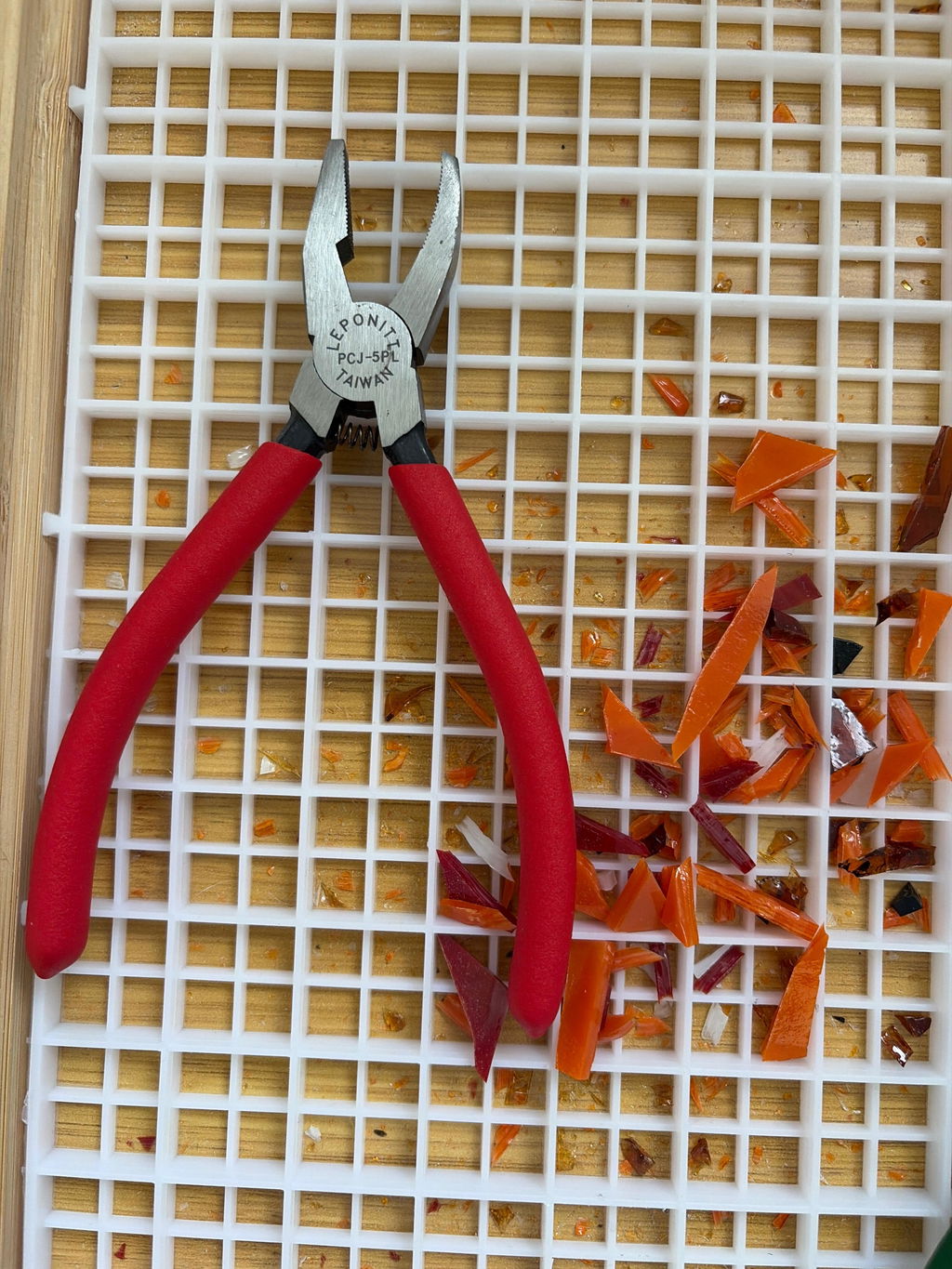
The thinnest variant (0.2 cm) can be beautifully worked with a wheeled nipper. The material yields without splintering, making it ideal for fine detail work and for artists with less hand strength.
A Softer Approach
Sintered glass requires a lighter hand than traditional glass. Striking too hard can lead to crushing instead of a clean break. Practice on scraps first to get to know the material – it will reward you with predictable, precise work.
Grouting: A Word of Warning
The matt, slightly porous texture of Morassutti Eco-Smalti is beautiful – but requires attention when grouting. Dark pigments in grout can seep into the microstructure of the surface, especially with light colours. The result can be a grey haze that is difficult to remove.
Practical advice: Always test on a scrap first. Consider treating the tiles with an impregnating agent or rubbing them lightly with wax before grouting. This prevents pigment from seeping into the texture and makes cleaning easier.
The Colour Palette: From Basic to Special
The Morassutti collection includes a rich palette of colours, organised into series that each have their own character.
The BF-series (Basic/Fondo) forms the backbone of the collection: honest, pure colours with descriptive names. Nero for the deepest black, Bianco for the purest white, and in between a spectrum of Verde, Giallo, Rosso and many others. Special is the Carnagione-series – a carefully curated palette of skin tones that optimally utilises the matt texture of the material for figurative work.
The K-series offer richer, more saturated colours – the shades that require more precious pigments. And for those looking for something very specific, Morassutti offers the possibility of custom work: a colour to order, exactly tailored to your project. Thanks to the powder process, every shade can be reproduced – a luxury that is much more difficult to achieve with traditional melting furnaces, where every batch is unique.
Applications: Where Beauty Meets Function
The versatility of Morassutti Eco-Smalti makes it suitable for a broad spectrum of applications:
- Portraits and figurative work: The matt texture is unparalleled for depicting skin, hair, textiles – everything that requires softness and warmth.
- Natural subjects: Feathers, leaves, tree bark, water at rest – the organic quality of the material resonates with organic subjects.
- Backgrounds and colour fields: Where glossy glass can distract, Morassutti offers calm. It steps back modestly, allowing focal points to shine.
- Combined work: The dialogue between matt and glossy, between absorption and reflection, opens new dimensions in your compositions.
- Sustainable projects: For public art, architectural installations and projects with environmental certifications, the high content of recycled material is a strong argument.
- Jewellery and fashion: The ultra-thin 2 mm variant makes applications possible that were previously unthinkable for glass mosaic.
FAQs
Why does Morassutti feel different from traditional smalti?
The difference lies in the production process. Traditional smalti is completely melted, which yields a smooth, glossy surface. Morassutti is sintered: glass powder is pressed under high pressure and then heated at lower temperatures. The glass particles only fuse together at the edges, resulting in the characteristic soft, matt texture.
Is it really safer to work with?
Yes. Traditional glass production used lead and arsenic – toxic substances that are released as fine dust when you cut or break the glass. Morassutti has completely eliminated these substances. For anyone who regularly works with mosaic, and certainly for workshops and educational settings, this is an important health benefit.
Can I combine Morassutti with other materials?
Absolutely, and this is exactly how many masters use it. The standard thickness of 0.6 cm corresponds to many other mosaic materials, allowing you to process them in the same glue bed. The dialogue between the matt Morassutti texture and glossy traditional smalti can give your work an extra dimension.
Why should I choose the Piastra instead of loose tiles?
The 11.5 x 11.5 cm sheet gives you freedom. You are not limited to the shapes someone else has cut for you. Every line, every curve, every shape your vision requires, you can cut from the sheet yourself. The material serves your art, not the other way around.
How do I prevent stains when grouting?
The matt texture can absorb pigments from grout, especially with light colours. Always test first on a scrap. If necessary, treat the tiles with an impregnating agent or wax before grouting. And work with unpigmented or light-coloured grout whenever possible.
Is it suitable for outdoor use?
Yes, especially the 1.0 cm thick variant is robust enough for outdoor applications. Ensure a suitable substrate and use frost-resistant glue and grout. The material is resistant to weather influences and temperature fluctuations.
What tools do I need?
For the thicker variants, a mosaic hammer and hardie works best – preferably with a widia (carbide) head for clean cuts. For the thin variant and precision work, a wheeled nipper is ideal. Remember: a lighter tap gives better results than brute force.
Why is the matt texture ideal for skin tones?
Human skin reflects light in a soft, diffuse way. High-gloss glass does exactly the opposite: it reflects light hard and directly, which breaks the illusion of warmth and softness. The matt texture of Morassutti approaches the way real skin interacts with light much better, making portraits look more lifelike.
Can I have a specific colour made?
Yes. One of the advantages of the powder process is its reproducibility. Morassutti can make custom colours by adjusting the proportions of the powder mixture. This is particularly valuable for restoration projects or large works where colour consistency is essential.
What makes this material sustainable?
Over 90% recycled glass. No lead or arsenic. Lower production temperatures. Fully recyclable at the end of its life cycle. Morassutti Eco-Smalti is designed with respect for people and the environment – without compromising on artistic quality.
The Story Continues
In Sequals, in the shadow of Spilimbergo, Federico Morassutti continues to work on his vision: materials that combine the warmth of the earth with the light of glass. Materials that honour tradition by renewing it. Materials that are sustainable in both senses of the word – made to last for generations, and made with respect for the generations that come after us. When you work with Morassutti Eco-Smalti, you become part of that story. A story of craft, of innovation, of beauty with a conscience.